What Is a LaTeX Resume? Build One Free Without Coding
A LaTeX resume is a typeset PDF with a clean ATS text layer. Here is what that means, why it beats Word and Canva, and how a resume builder can give you Jake’s Resume without writing syntax.
7 min read · Updated September 2026
A LaTeX resume is a resume typeset by the same engine that prints scientific journals: deterministic layout, real Unicode text, no floating text boxes. That is the text layer Workday, Greenhouse, and Lever actually parse. You do not have to write LaTeX to get one — a resume builder can fill Jake’s template from a form and compile the PDF in your browser.
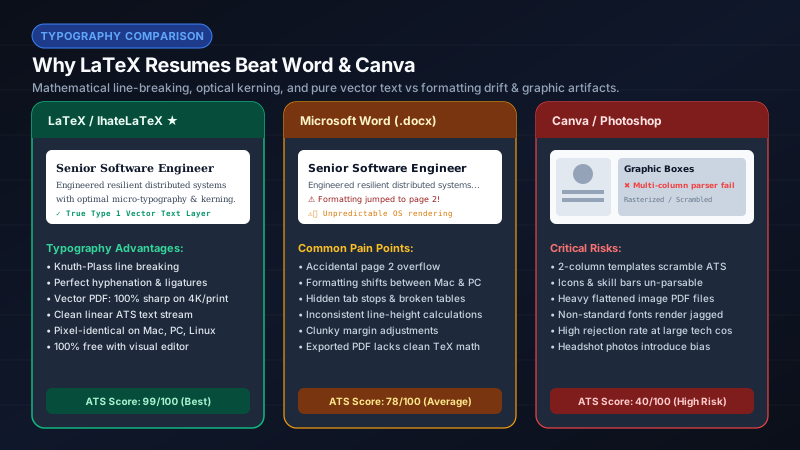
Why LaTeX resumes outperform Word and design-tool resumes
- Deterministic layout: no accidental text-box drift; the document model is a single logical stream.
- Machine-perfect encoding: pdfTeX’s glyph-to-Unicode mapping guarantees parsers see real characters, not garbage glyphs.
- Typographic credibility: consistent spacing and professional type signal attention to detail — especially in engineering cultures where LaTeX is the lingua franca.
- Reproducibility: your .tex source rebuilds your resume identically in 10 years; no format rot.
The traditional cost: syntax
Classically, getting a LaTeX resume meant installing TeX Live (gigabytes), finding a template like Jake’s Resume, and debugging errors like "Misplaced alignment tab character &". That cost is why most candidates settle for Word. It is also the exact problem IhateLaTeX removes: you fill a form, it writes the LaTeX, and a WebAssembly TeX engine compiles the PDF in your browser in about a second — free, private, and on-device.
What "Jake’s Resume" is and why it became the standard
Jake’s Resume is an open-source LaTeX template by Jake Gutierrez that became the de facto tech-industry standard on r/cscareerquestions and engineering recruiting circles. Its single-column layout, small-caps section headings with rules, and tight but readable margins are tuned for both 6-second human scans and ATS parsing. IhateLaTeX generates this template (plus Classic, Modern, and Executive variants) from your form data — with every section, color, and spacing under your control.
How to make a LaTeX resume without coding — step by step
- Open IhateLaTeX in any modern browser — no install, no account.
- Fill the section forms (contact, experience, education, projects, skills). Your data autosaves on-device.
- Pick a template and design options in the Design & typography panel.
- Run the ATS Score check and apply the suggested fixes.
- Download the PDF — or the .tex source if you want to keep hacking in Overleaf.
Frequently asked questions
Do recruiters care if a resume is made with LaTeX?
They care about the result: LaTeX resumes look consistently typeset and parse cleanly. In engineering and academia, LaTeX output is also a subtle positive cultural signal.
Is LaTeX better than Word for resumes?
For parsing reliability and typographic quality, yes. Word’s free-form canvas invites layout choices (columns, tables, headers) that ATS parsers mishandle; LaTeX’s document model avoids them by construction.
Can I edit the LaTeX code IhateLaTeX generates?
Yes. The LaTeX source card shows the full generated .tex; copy or download it and continue in Overleaf or a local TeX editor. It has no proprietary dependencies.
Does it cost anything to compile LaTeX with IhateLaTeX?
No. Compilation runs on your device via WebAssembly, so there are no server costs to pass on — the tool is free with no limits.
Related guides
- Jake’s Resume LaTeX Template: The Complete 2026 Guide · 11 min read
- How to Use Jake’s Resume Template: Step-by-Step (No LaTeX Required) · 9 min read
- What Is IhateLaTeX? The Free Private LaTeX Resume Builder Explained · 7 min read
- Best Free LaTeX Resume Templates in 2026 (Ranked & Compared) · 9 min read
Put it into practice
IhateLaTeX applies everything in this article automatically: ATS-safe templates, XYZ-bullet scoring, and pixel-perfect LaTeX — free, private, and compiled in your browser.
Build my resume free