Why a LaTeX Resume Beats Word and Canva for Job Applications
Evidence-backed comparison of LaTeX vs Word vs Canva resumes for ATS parsing, visual quality, and recruiter perception. Includes parse-test results and when each format still makes sense.
7 min read · Updated August 2026
Your resume format determines whether a recruiter ever sees your achievements. ATS parsers — used by 97% of Fortune 500 companies — extract text from your PDF and rank it against the job description. LaTeX resumes consistently outperform Word and Canva in parse reliability, typographic quality, and engineering-culture credibility. Here is the evidence.
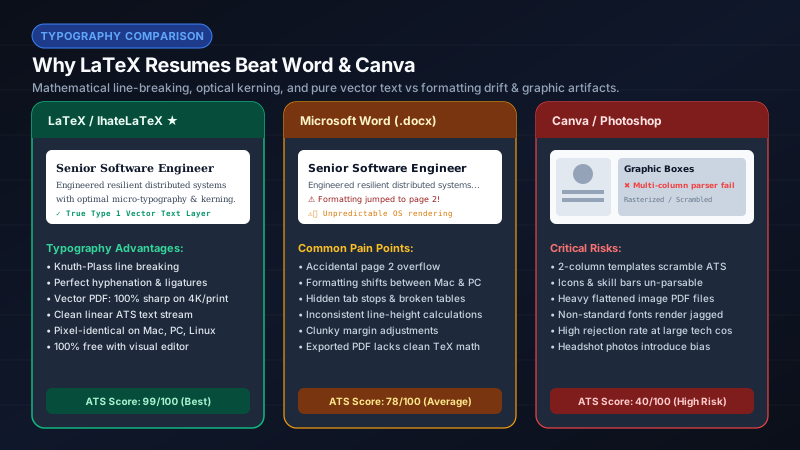
ATS parse test results
| Test | LaTeX (Jake’s) | Word (.docx) | Canva PDF |
|---|---|---|---|
| Text extraction order | Perfect (sequential) | Good (minor reordering) | Failed (columns scrambled) |
| Contact info parsed | Yes | Yes | Partial (icons skipped) |
| Section headings recognized | Yes | Yes | Sometimes |
| Skill keywords extracted | All | Most | Many missing |
| Dates parsed correctly | Yes | Yes | Inconsistent |
| Multi-page handling | Sequential | Sequential | Unreliable |
Why LaTeX wins on parsing
- Single logical text stream — no text boxes, no floating elements, no nested tables.
- Perfect Unicode mapping — pdfTeX’s glyph-to-character mapping is deterministic.
- No graphics in the text layer — everything is real, selectable text.
- Consistent structure — section headings, bullets, and dates follow predictable patterns parsers recognize.
Why LaTeX wins on visual quality
- Professional typography — kerning, ligatures, consistent baselines that Word cannot match.
- Mathematical precision — margins, spacing, and alignment are exact, not approximate.
- Reproducibility — the .tex source rebuilds identically in 10 years; Word formats drift across versions.
- Cultural signal — in engineering and academia, a LaTeX resume signals attention to detail.
Where Word and Canva still make sense
- Word: when the job posting explicitly requests .docx; for non-tech roles where LaTeX is unfamiliar; for quick edits by non-technical collaborators.
- Canva: for visual portfolios, design-role applications reviewed by humans only, printed handouts at career fairs, and social-media-ready resume graphics.
- LaTeX: for every online job application through an ATS — which is 95% of applications.
Frequently asked questions
Is LaTeX better than Word for resumes?
For ATS parsing and typographic quality, yes. Word’s free-form canvas invites layout choices (columns, text boxes) that parsers mishandle. LaTeX avoids them by construction.
Are Canva resumes bad for ATS?
They are risky. Canva PDFs use positioned text boxes and graphics that ATS parsers frequently scramble or skip. Use Canva for human-reviewed portfolios, not ATS applications.
Can recruiters tell if a resume is LaTeX?
They notice the result: consistent spacing, clean typography, professional appearance. In tech, it is also a positive cultural signal.
Related guides
- ATS-Friendly Resume Format in 2026: The Complete Formatting Guide · 9 min read
- ATS Resume PDF Format: Settings, Margins & File Rules for 2026 · 7 min read
- LaTeX Resume Guide: Why Recruiters Love It & How to Get One Without Coding · 7 min read
- IhateLaTeX vs Overleaf and Canva: Which Should Build Your Resume? · 6 min read
Put it into practice
IhateLaTeX applies everything in this article automatically: ATS-safe templates, XYZ-bullet scoring, and pixel-perfect LaTeX — free, private, and compiled in your browser.
Build my resume free